▸ Why is the developing nose less tolerant to smoke?
▸ Short-term signals and long-term costs at a glance
▸ What can parents and adolescents do respectively?
# Smoking's Impact on Adolescent Nasal Development and Olfactory Function
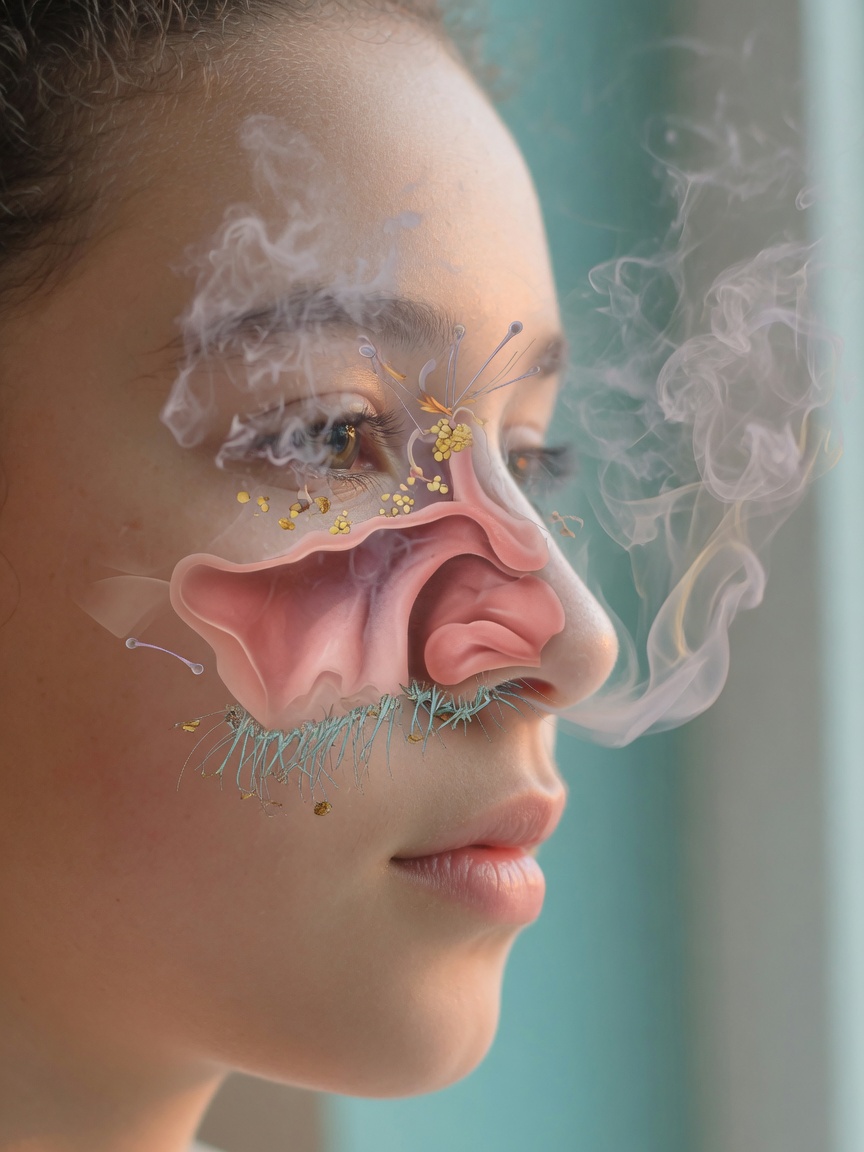
The nose is not just the "entrance for breathing"—it is also the outpost for air filtration, humidity regulation, and odor perception. For adolescents who are still in the growth and development phase, the nasal mucosa, mucociliary clearance system, and olfactory epithelium are still in a stage of consolidation and continuous renewal. Cigarette smoke—whether from direct smoking or long-term exposure to secondhand smoke—first contacts and is most easily repeatedly "washed over" precisely this still-developing defense line.
This article is aimed at parents and adolescents, striving to clearly explain the mechanisms: why the developmental stage is more vulnerable to damage, what short-term discomfort truly means, and what long-term functional costs may remain. Serious, but not preachy; concerned about consequences, but not using fear as the sole persuasive tool.
I. The "Unfinished State" of the Adolescent Nasal Cavity and Olfactory System
Puberty is often discussed in terms of height, bones, and secondary sexual characteristics, but the nose and sense of smell rarely enter family conversations. In fact, the structures related to the nasal cavity undergo important shaping and functional maturation from childhood through adolescence:
1. The Nasal Mucosal Barrier is Still "Training"
The nasal surface is covered by respiratory epithelium and localized olfactory epithelium. Healthy respiratory mucosa relies on a mucus layer to trap particles, and then uses rhythmic ciliary beating to transport debris backward—this is the mucociliary clearance system. If adolescents are repeatedly exposed to irritating smoke, this system enters high-intensity wear before it is fully hardened, making repair and damage more prone to imbalance.
2. Immune and Inflammatory Responses are More "Sensitive"
Tobacco smoke contains a large number of particulate matter, oxidants, aldehydes, polycyclic aromatic hydrocarbons, and other irritating components. They can trigger the release of local inflammatory mediators, causing mucosal congestion, edema, and abnormal secretion. The developing respiratory tract is already more sensitive to infection and allergies; smoke adds a layer of chronic irritation on top of an already sensitive foundation.
3. Olfactory Neurons are "Directly Exposed" and Continuously Renewing
Olfactory receptor neurons are located in the olfactory epithelium at the top of the nasal cavity, with dendrites extending into the mucus layer, almost face-to-face with inhaled airflow. They renew throughout life, relying on progenitor/precursor cell replenishment. This "renewability" is a hope for repair, but it also means: when smoke repeatedly kills mature neurons and inhibits progenitor cell proliferation or differentiation, the renewal chain gets stuck, and olfactory function declines.
4. The Earlier the Start, the Longer the Cumulative Exposure
From a public health perspective, starting smoking in adolescence is not just a matter of "whether it hurts now," but also prolongs high-risk exposure over decades. Many changes in the nasal mucosa and olfactory epithelium are dose- and time-dependent: the more and longer one smokes, the more difficult structural and functional recovery typically becomes.
In short: An adolescent's nose is not a "small adult nose," but a tissue system still developing with high turnover; the same wisp of smoke, landing on a developmental window, often exacts a greater cost than in adulthood.
II. Where Smoke Strikes First: Nasal Mucosa and Ciliary Defense
When smoking, the high-temperature airflow and complex chemical mixture first sweep through the nasal vestibule, turbinates, and the entire nasal passage. For the nasal mucosa, the common pathways are generally as follows.
1. Cilia are Damaged, Cleaning Slows Down
Chronic smoke exposure is associated with pathological changes in the respiratory epithelium: cilia become flattened, shortened, reduced in number, and their beating efficiency declines. The result is that dust, pathogens, and allergens remain longer in the nasal cavity, more easily triggering repeated infections or persistent "rhinitis-like" symptoms—nasal congestion, runny nose, postnasal drip, and throat discomfort.
2. Mucus Secretion is Disrupted—Dry and Blocked
Smoke stimulation can increase goblet cell count and alter mucus properties. Some people exhibit hypersecretion (constantly wanting to blow their nose), while others later develop mucosal dryness, crusting, and a burning sensation. Adolescents often mistake these for "seasonal allergies" or "excessive internal heat"; if there is a history of smoking or secondhand smoke exposure, smoke irritation should be considered rather than repeatedly relying on cold medicine.
3. The Mucosal Barrier is Torn Open
Intact epithelium is like a city wall. Oxidative stress and chronic inflammation can weaken cell junctions and local defenses, altering the bacterial colonization environment and increasing infection risk. Studies on passive smoking in children and adolescents also suggest that long-term secondhand smoke can cause ultrastructural changes in the nasal mucosa and is associated with various upper respiratory issues—"I didn't smoke, someone nearby did" does not equal zero risk.
4. Mutual Reinforcement with Allergies and Sinus Issues
Smoke is not a typical "pollen allergen," but it can exacerbate mucosal hyperreactivity, making symptoms worse and medication harder to stop for children already prone to allergic rhinitis or sinusitis. For parents, smoke control is sometimes an underestimated part of allergy management.
III. Olfactory Neurons: Sensory Nerves Directly Exposed
If nasal congestion affects "ventilation," olfactory damage affects "a layer of information for perceiving the world."
1. Why is the Olfactory Epithelium Particularly Vulnerable to Smoke?
2. What Might Adolescents Notice First?
It may not be "completely unable to smell"; more common are subtle changes:
These changes are not easily discussed in social settings, but they can quietly alter appetite, mood, and interest in food. If parents only focus on coughing and grades, they can easily miss this olfactory clue.
3. E-cigarettes and Heated Tobacco Are Not "Automatic Safety Cards"
Different products have varying harmful substance profiles and temperatures, with different effects on the lower respiratory tract, but any aerosol/smoke inhaled through the mouth or nose has the nasal cavity and olfactory region as one of the primary sites. Replacing "no stimulation" with "a little less stimulation" does not hold true during development. For adolescents, the safest medical stance remains: avoid the formation of nicotine dependence and avoid the regular use of any tobacco product.
IV. Short-Term Discomfort and Long-Term Consequences: From Symptoms to Function
Short-term (days to months)
The significance of these signals is: the mucosa is already working under overload. They are not proof that "the body has gotten used to it," but an alarm of coexisting damage and compensation.
Medium to Long-term (months to years of continuous exposure)
A Point Worth Clarifying on a Lifetime Scale
What is damaged during adolescence is not just "whether you feel comfortable now," but:
Long-term effects don't need to be exaggerated as "one puff equals permanent blindness-like anosmia." A more honest statement is: there is reversible potential, but also risks that may not be fully reversible; what is at stake is one's own sensory system and quality of life decades later.
V. Passive Smoking is Also Not "Safe Spectating"
The conflict point in many families is: "I smoke on the balcony / I opened the window." For the adolescent nasal cavity, the key variable is whether tobacco combustion products are repeatedly inhaled, not the smoker's self-comfort.
Passive exposure can still:
For parents, this is an issue of attitude as well as environmental medicine: protecting the developing airway is more important than winning the argument "I have the right to smoke." If you can smoke outdoors away from children or maintain a completely smoke-free home, do not use "I'll come in after smoking" as a pretense of harmlessness—residue on clothes and in exhaled breath can still constitute thirdhand smoke burden.
VI. What Parents Can Do, What Adolescents Can Choose
For Parents: Less Judgment, More Facts and Boundaries
For Adolescents: You Have the Right to Know the Mechanisms, Then Make Your Choice
Simple Self-Check Questions (Not Diagnostic)
If multiple answers are "yes," it is worth seriously considering stopping exposure and consulting a doctor when needed.
VII. Conclusion: Building the Choice on Facts
The harm of smoking to adolescents is often simplified into distant posters about lungs and cancer. The nasal cavity and sense of smell remind us: damage can come very close—right on the mucosa and neurons that every breath passes through. The high turnover and high sensitivity of the developmental period are an advantage of growth, but also a vulnerability during exposure.
What parents can do is provide a smoke-free environment and verifiable facts, not humiliation. What adolescents can do is understand: the nasal mucosa and olfactory function are intimately related to respiratory comfort, dietary pleasure, emotional nuances, and even safety warnings—they are worth protecting.
The serious conclusion is actually very short—
A developing nose cannot withstand being used as a chimney; the sooner you leave the smoke, the greater the chance to reclaim the right to repair.
Key Points Summary
This article is for health education purposes and cannot replace individualized medical advice from a licensed physician.